Friday, December 25, 2020

The Gift of Love

  I enjoy the quiet of Christmas day.  The heat pump is enjoying the weekend off, so I am holding and sipping a hot mega-mug of coffee in front of the fire listening to some music from WBHM.  I have not tried to write anything for awhile. There was just too much noise. It was easy to write things that would be cheered by some and condemned by others. Great for the ego and a lot of fun sometimes.  But suddenly it seemed impossible to write anything helpful. That is a bit of a lie. Truthfully I was a little afraid. 

But on this day I am reminded once again that there is no place for fear if I am to celebrate the loving God who comes, even now, and who came as a baby,  born into the most ridiculous fearful circumstances. But Mary and Joseph were told not to fear. The shepherds were told not to fear. And it appears that they  overcame their fear.  So obviously, I have to just get over it. And maybe you do too.

So indulge me and let me tell you what I am being reminded of today. 

The whole thing started with love. For God so loved. It is a love that will never end.  What did, what does, God love?  The world.  That is pretty much everything.  All of creation. This magnificent, beautiful, interwoven complex work of water, earth, heavens and life. Including every human being that ever drew a breath and ever will. This little baby that we sing about, celebrate in worship and in giving gifts, was God coming to love creation to redemption, including all of humanity, all of us.

That precious baby in the manger grew up. Jesus did a whole lot of teaching before we killed him.  Sometimes, it seems to me, we forget that part.  It seems we want to graduate without going to class.   Being saved is a wonderful thing.  Being told how we should live is a different matter.  But fear not. We are in good company. The disciples and others were notorious for having suggestions of their own.  Those conversations with Jesus never went well.  And it is the same for us. All of us. 

So what does Jesus want of us?  Sometimes in my prayers I arrogantly ask God what am I to do?  Inevitably God speaks to my heart. Thankfully God is patient. God reminds me that Jesus has already come to redeem the world. Another saviour is not necessary. Jesus taught us, with a perfect life and the most perfect words ever spoken with such economy, what is required of us.  To love as God loves, that is, universally, sacrificially, abundantly and unconditionally. To serve all as Jesus did, humbly, and without regard to status. To forgive.  And not to judge, God will take care of that.

Jesus told us to stand with the oppressed. To set the captives free. To take care of the poor and all in need. To welcome the stranger.

So, most of the time the answer to my prayer is "Well, Bob, I've already told you what to do. I'll let you know if I need something specific." 

That's pretty much it. And it is enough. The love that Jesus taught us about is the answer we pray for, especially in times like these.  

It all began with Love. God's love.  But the answer we so desperately seek has already been given to us. By the one who was born in the manger.  Certainly it is empowered by God's love. But it is our sharing of God's love with the world, sharing our love,  as Jesus taught, that is the answer we seek.  

This truth causes more controversy than anything else I have ever written about, and it will, until we give it a try.

This truth is why Jesus was born.  And why he was killed.

Merry Christmas.


Saturday, December 8, 2018

Go, look and listen

Saturday. Sofa. Coffee.

A perfect morning to sit on the sofa and drink coffee.  It is wet and cold and dark outside.  But here on the inside the heat pump hums gently in the background, a curl of coffee vapors climbs out of the pot and fills the room, and the sofa, conformed by many other mornings and evenings of our time together, calls me once again to sit down and get comfortable.

And so I do. At this time of morning on this kind of day I like to keep the house a little dark while I sit, the only light being the grey of early morning filtered through thick rainy clouds, and one lamp on the table next to the sofa, filling the corner of the room with soft light.

Even soft light reveals hard things. Light is light. It reveals truth. It extinguishes darkness.  And this morning, as I nestled into my comfortable place, the light was gently brutal as it directed my eyes.  There in the corner of the room, leaning against the wall for several months waiting to be hung, illuminated by the lone lamp in the room like a museum piece, was a block print by Birmingham artist Debra Riffe.  I bought it because it provoked me.  I suppose I let it sit out of the way for months because I did not want to be provoked.  But the light grabbed it this morning.  This lively, artful expression that so provoked me deserved better.  But it was hard to fit into my comfortable corner of the world, at least in a place high enough to be noticed.

This art form sometimes creates a look similar to a theater or concert poster.  In this print there stands an older African American man playing an acoustic guitar strapped around his neck.  The poster reads "I ain't fixin' ta sit down."

I do not presume to know what brought the man in the print to make that proclamation.  In my mind's eye I see the man to be of an age that our years of life would overlap, and so honestly, it would be willful ignorance if I could not form a general idea of reasons for his defiance or the message of his music.  

There are a few things I can learn from the print leaning against the wall of my den.  There are songs of life being sung all around us. It is important that there is time and space for the songs to be sung, but more importantly,  that those songs be heard by those who need to hear. 

But it is just a print.  Ink on paper.  I cannot hear the notes of the music being played, the specific words being sung by looking at the print.  The artist has done her job.  She provoked me to want to hear the old man's song.  Thank goodness for the light of this morning.

I must leave my comfortable corner to hear the songs. I might want to turn away.  I might want to sing along. 

But before I do anything, I must go and listen. 

. 


Saturday, August 25, 2018

Can't see the forest for the trees, or is that poison ivy?

Saturday. Sofa. Coffee.

Last Saturday I worked in my yard. Actually it used to be my yard.  I like to think of it now as a second growth forest.  That's a real thing, look it up.  I'm thinking of putting up one of those dignified woodsy roadside signs at the foot of my driveway, maybe made of cedar, that declares my yard to be a Certified Alabama Second Growth Forest.  Not really.  I'm going back out there after while and get to work, just as soon as it gets hot enough.

Last Saturday I was cutting up a fallen tree.  After I finished I was not ready to put away my chain saw since it was running fine and one must take advantage of that good fortune when it arises.  At the edge of my once and future yard stands a hickory tree.  I really love trees, especially hardwoods, and in particular hickory and oaks, so no, I was not thinking about cutting down this beautiful tree.  On the contrary, I sensed that the time had come for a risky maneuver to save the life of the hickory.  Sure it was dangerous, but I had been putting it off for awhile.  It was time to slash the grossly monstrous vines that were attached to the tree like the sea creatures that made up Davy Jones beard in the Pirates of the Caribbean.   The ugly tentacles climbed and crept to the top branches, displaying the vines' oily deep-green leaves and clusters of berries like a pirate's flag at the top of a conquered mast.  There was no skull and crossbones.  But there should have been.  These vines were poison.  Poison Ivy.

Perhaps that's a little too dramatic.  But seriously, I am very sensitive to poison ivy resin and the mere thought of cutting through those hairy one and two inch vines was enough to shorten my breath and raise whelps on my skin.  On the other hand, I have seen what these insidious vines can do to otherwise healthy trees.  They kill them.  Slowly.  The green leaves of the vines become entangled with the leaves of the tree, so it is difficult to notice that the tree is dying, limb by limb, until it is too late, and most of the green that remains belongs to the poison vine, and not the tree that still supports the vine, even to death.  

I checked on the tree this morning.  Now it is easy to distinguish between the leaves of the choking vine and the leaves of the tree.  The leaves of the vine are now wilted and withered, all the way to the top of the tree.  I had no idea how far the poison vine had invaded the hickory tree.  I hope I cut the vine in time.

Last week I cut the big, hairy, ugly vines near the base of the tree.  The vines above the cut were dead this morning, all the way to the top of the tree.   But below the cut in the vine there was already new growth. Three leaves. One jag on one edge. Deep, oily green. Heading up the tree.  The vine is still rooted in the soil, just like the tree. 

And that's the problem.

.

Saturday, December 16, 2017

Wake up, it's getting light


Saturday. Sofa. Coffee.

Everything is still on the hill this morning.  Not a creature is stirring, not even a possum. The gentle light of the rising sun is kind, like a parent letting an adolescent child sleep late on the first days of Christmas break.  Nothing is moving, frozen by the cold air of the night.  But the still and quiet are beautiful, and welcome.  My plan is to blow a mountain of leaves off the hillside later, but they are still frozen to the ground, so dagnabbit, I will just have to lie here and drink coffee for awhile.   My heart is being warmed, literally, by my bowl of coffee that sits on my chest as I write while lying back on my sofa, custom fit to my body from hundreds of mornings of waking up.  Like the world outside my windows,  I have not completely committed to starting the day.   I will leaf here soon enough.  Sorry about that.  Not really.

I have never been more ready for Advent.  In my Christian faith tradition, United Methodist, Advent is a period of time, the first month or so of the Christian year before Christmastide (not to be confused with Crimson Tide), a time of waiting and preparation. Advent is a time for pausing to remember the coming of Jesus into the world, and to wait,  prepare for and anticipate what God will do next.

Like my Christmas shopping, my intentional observance of Advent is getting a late start this year.  Some of my prayers of late have included remembering, mostly out of a desire for assurance, and anticipation, mostly out of a desperation for God to do something.  So perhaps Advent for me started out of necessity rather than intentional liturgical practice. 

Maybe that is the way it is supposed to be.  Maybe that's the way folks felt 2000 years ago.  Desperate hope for many came from remembering when God did mighty acts centuries before, and anticipation of the time when the promises of God would come to pass.  There was liturgy back then too.  Judaism, the faith that Jesus was born into and practiced, included liturgy of remembrance and anticipation long before Jesus was born.  Faithful Jews knew it well.

But I wonder if the Jews at the time were much different from me.  The liturgy and scripture that was so dear and familiar to them informed them of how it was supposed to be.  But maybe the world around them made it real.  Oppression. Poverty. War. Cruelty. Inhumanity.  The ancient histories and promises had told them where hope was to be found.  But the mean world required that the hope of history become real in the present. The pain of the present required that the promises be fulfilled now.

I doubt that there is anyone who is not weary of the battles of this world right about now.  But in the darkness even a small light is bright.  Perhaps that is why we are moved to tears by unexpected hopeful signs, or small acts of kindness recounted on social media or acted out in the check out lane, or why we linger to talk instead of passing hurriedly by when an old friend greets us on the street, or why our hearts melt from the grins and giggles of an innocent child, eyes filled with the wonder.

So, this year, as always, it is good and healthy to pause, to remember,  to watch and wait, to anticipate.  Because there is light in the darkness.  It started as the tiniest, white-hot, pin-point of light that appeared in Bethlehem a long time ago. 

And it has pierced once and for all the darkness of our long night.  And is still warming up our world.  Like a gentle parent, waiting for us to wake up.


.

Saturday, May 27, 2017

America's favorite videos (and the ones no one shares) . . .

Saturday. Sofa. Coffee.

I have a confession.  Even as every day brings more serious news about the state of the world,  I watch video of our President and laugh.  I can't help it.  This week was like a greatest hits reel.  

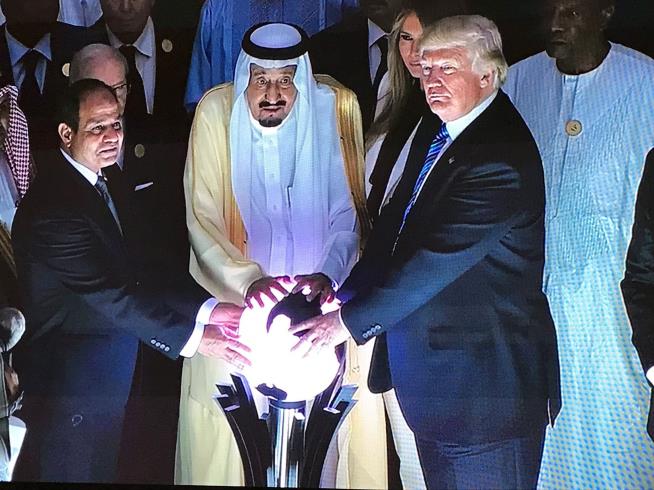
There was the pre-arranged photo-op with President Trump huddled with Arab country leaders around a brightly glowing orb.  Each leader had his hand on the orb.  The photo-shoot was scheduled to highlight Saudi Arabia's new Global Center for Combating Extremist Ideology, which could be the subject of a whole series of serious posts.  But instead I wondered if this was what the old ABA (American Basketball Association) would have looked like today right before tip-off, if it had not merged with the NBA.   "Three, two, one . . . launch ... we mean team!!!"   Or I wondered if this was a trailer for a new Harry Potteresque kind of book series . . . "President Trump and the Golden Orb."  Or,  well let's just say I wasted a lot of time on the possibilities.   I was not alone. We invested a lot of creativity as a country captioning this one.  Perhaps I will do some serious research on Saudi Arabia's new GCCEI.  But this week I laughed.

Another photo-op at the NATO meet and greet cause me to smile.  We have all been to family reunions and a cousin wants everyone to line up for a group photo.  Some of us love it, some of us hate it, especially when one of our relatives has gotten on our last nerve.  Apparently President Trump was in the "love it" category as he appeared to do a football pass-rusher-swim-move to get to a place in the front center of the photo shoot.  He made the new Prime Minister of Montenegro look like the rookie that he is.  The video created an international conversation as to whether Trump's move was rude, or just the opposite, the result of his unexpected execution of a "man-hug."  Historians will have the final word.  But as for me, I looked at it and laughed.

There were hand-holding controversy videos as Melania seemed to refuse to take the President's hand a couple of times.  Maybe she did not want to hold his hand.  Or maybe she had actually paid attention to briefings which might have suggested that public PDA was not a good thing in Saudi Arabia and was trying to act accordingly.   There was a sword dance video which is the kind of thing all our Presidents seem to get trapped into. And there was the look on the Pope's face debate.  I know all of these things had serious ramifications, which may appear in a later post.  But they made me laugh.

It is too bad that things are so serious these days.  I think it is generally healthy for our democracy to be able to chuckle, good naturedly, at the person we have chosen to be the leader of the free world.  But in the serious context we find our world in, it is hard to know what to laugh at, or who to laugh with.  That's a shame, because nothing is more healing than a good laugh with friends.  Who can forget Obama's mom jeans or George W's mangling of "fool me once . . .?"   

The videos are everywhere.  From podunk blogs like this one to the great news outlets of the world, we were kept abreast of breaking gaffes.  Everyone had a caption, or an opinion. Many of us laughed or derided, many of us ignored or defended.  I am not being critical of the coverage. After all, the laughter this week probably added a couple of hours to my life.

But other things were in the news this week.  And the subject matter will not add hours to any one's life. Just the opposite.  Years of life will be taken away. 

Life will be taken away from folks who will never worry about the protocol of the highest levels of society or politics in Saudi Arabia or Europe. Life will be taken away from the least of these among us. And while these matters of life and death were covered with the time and column inches that remained after the afore-mentioned gaffe coverage, very little of it has been shared and tweeted and re-shared and re-tweeted.  The images do not make us laugh or smile.

In President Trump's budget proposal released this week, a significant number of children, elderly and sick will find it difficult, more likely impossible, to get medical treatment for illness.  Food and medicine will likely not be available to a significant number of these, the least among us.  Some who are already weary of battling illness will find it impossible to get medical treatment for the illnesses that have plagued them. Some will be forced to watch their children die for lack of medical treatment.  Children will go hungry.  In the USA.

Generally, the budget will cut $800,000,000,000, that's eight hundred billion dollars, from medicaid over the next ten years.  It will cut $192,000,000,000, that's one hundred ninety two billion from nutritional assistance.  It will cut another $272,000,000,000, that's two hundred seventy two billion, from welfare programs. It will cut $72,000,000,000, that's seventy two billion, from disability benefits.  College loan subsidies for the poor will be slashed.  

This does not include the effect of slashing of budgets that insure clean air and water, and pay for research for cancer, heart disease, AIDS and other life threatening illnesses.

I am confident this budget will affect a significant number of the least of us. 

What is a significant number, anyway?   If it is my child, then one is significant.  But if it is not my child, or my parent, or me, what is a significant number?  Ten?  A hundred?  Thousands? Or does it not matter at all if it's not my child, or my parent?

Under the proposed budget it will be more than one who will suffer or die.  More likely in the millions.  It will affect someone you know and care for.  If not, maybe you need to expand your circle a little.

I wish our President were capable of more decorum.  I wish he were not so belligerent.  I wish he acted more "presidential," bless his heart.   Changing his image is the one thing he might be able to do, he is a branding expert, after all.  But changing his image is also the least important thing he might do.  In fact it is his image that many Americans really like.

But image doesn't matter to the poor, the sick, the dying, the hopeless.  

Policy matters. Health care matters. Food matters. Education matters. Environment matters.

And right now, President Trump is proposing a budget of death and pain for millions of our fellow citizens.

And no one can laugh at that.  Especially if there were videos to share.


Saturday, May 6, 2017

Candy bars and false equivalence

Saturday. Sofa. Coffee.

When I was a young child it was a regular experience to share the last piece of something, candy, cake, watermelon, mostly anything that tasted good, with a friend or sibling.  These moments of reasonable civility did not come naturally, as I recall.  Most times the sharing was done only after a few things happened.  First there may have been an effort by one or all parties present to surreptitiously snake the last sweet treat into one's palm or pocket without being seen. Sometimes there was just a bold, outright grabbing.  This was normally followed by a hue and cry from the other party.  The hue and cry escalated into a brouhaha (sorry, I just love this word).  At some point another presence entered the scene. An adult. A parent or a teacher, or a friend of parents and teachers seemed to be inherently attracted to these moments.  


"If you can't share the last piece, then nobody can have it,"  was the gist of what the adult normally said.  Sometimes that would result in the adult confiscating the goody, and, I always assumed but cannot prove, eating it themselves.  But usually all parties took a breath, weighed the options, and entered into negotiations.  


"Each of you take half of the last piece," the adult would say.  The wisdom of years is priceless.


Begrudgingly the parties would enter the process of carefully dividing the object of our desire.  Another argument might ensue.  It was quickly obvious, even to the young eye, that dividing something equally is difficult.

The adult voice might suggest, "Okay, one of you gets to divide it into two pieces.  The other one gets to choose which piece you want."   I could only hope to achieve that kind of maddening, Solomonesque wisdom someday.


Another crisis averted. 


 I learned a lot from those experiences. Eventually sharing in times of scarcity became natural, and all of those machinations of assuring exact equality seemed like a waste of time, not because it was not important to be fair.  It's just that it was impossible for things to be exactly equal. 


But sometimes, in the midst of the above scenario, another strategy was executed. 
The quicker, usually older party might grab the last precious prize, break off a small piece and with an exaggerated gesture of magnitude, give it to the other.  "There, you can have that.  Now we can both have some.  That's fair."  Even a slow, younger kid knows that ain't right and another hue and outcry would ensue.  "But you got some, I got some, we both got some, you can't get more fair than that," the older might protest. I laugh at that childhood memory now.  It was my first introduction to a concept called "false equivalence."  

False equivalence is a logical fallacy in which two opposing arguments appear to be logically equivalent when in fact they are not. This fallacy is categorized as a fallacy of inconsistency.  I got this definition off of Wikipedia, and it is a little high minded.  But bear with me.


A good example is in the news right now.  During the recent discussion and votes on the new health insurance bills passed by the U.S. House of Representatives this week many of the proponents of the quick vote publicly defended the rapid movement, saying it was no different than when the Affordable Care Act was passed during the Obama administration, saying that Obama's ACA was rammed through without input or discussion in a short time.  In other words, the Republicans who supported the new act said they were handled the same, so why should anyone complain?  


 The ACA was debated, in Congress, and in the public forum for almost a year, from the time of President Obama's address to Congress in early 2009 until it was signed into law in March, 2010. Changes were made at the suggestion of Republicans that were concessions by President Obama.  More than fifty Congressional hearings were held. Groups of insurers, medical providers, government and business entities were brought in to discuss and have input.  Citizens groups had almost a year to make their case one way or the other. The Congressional CBO did a cost-analysis of the bill.  Private think tanks of all stripes and persuasions had ample time and published their own studies. It was a long, laborious, public process.


In contrast the new American Health Care Act (AHCA) was not publicly proposed until March 6, 2017. It failed on its first vote in late March due to a split in the Republican majority in Congress. An amendment was proposed in late April. The bill was passed by the House on May 4, 2017, less than two months after it was first made know to the public, and less than three weeks after it was dramatically amended. There have been no hearings, no systematic input from business, healthcare providers, insurance companies, or other government entities, no CBO cost analysis or opportunity for private groups to do cost analysis. There has been little time for the public to digest the content of the legislation and express opinion, although some have done the best they could.


Forget policy considerations for the moment.  The point is, the process by which these two pieces of legislation were handled could hardly have been more different.  To suggest the rapid action by the House of Representatives was justified because President Obama's ACA was passed in the same manner is a false equivalence.  


And the reason for the creation of that false equivalence is worthy of pause and examination. 


We use false equivalence to justify our thoughts and actions. But if they are false, shouldn't we be concerned about the harm we are causing?  Or even if we believe the cause we are supporting or protecting is right and good, have we lost our moral compass in accepting, even promoting lies to get what we believe to be correct?


For another example, a politician lies on a daily basis.  His or her opponent, who does not lie often is caught in a lie.  The politician who lies daily stands up and calls his or her opponent a liar and that he or she cannot be believed.  The pundits and supporters who favor the politician who lies daily adopt the argument, "both of them have lied, that's just politics. How dare you criticize my candidate.  Your candidate lies too."  Regrettably it is true that both have lied. But clearly one lies much more than the other.  The acceptance of the false equivalence without question prevents a real examination of the respective character and qualifications of the candidates.  All politicians lie.  Don't get too smug. All of us normal people have lied too.  But the candidates are not equal in their propensity to lie.  It is a mistake to disregard a true inequality in character. But that is what we do when we accept a false equivalence without pause or examination.


Statements of false equivalence pop up in all of the political and policy issues that we face today.  Equal opportunity. Equal justice. Gender equality. Tax policy. Crime and punishment. Poverty. Even health and pre-existing conditions.  Nothing is simple.  These problems cannot be addressed by a dismissal of reality that comes with false equivalence. The truth is, equivalence is usually impossible to achieve. Perhaps theoretically, as in mathematics, it can be done.  But in the real, physical world, and in the world of thought and ideas, perfect equivalence is difficult.  It would have been virtually impossible for us kids to perfectly divide the candy bar.  We can get close to equivalence, and learn to accept the slight imperfections in our calculations.  But some inequalities are significant and are worthy of examination in dealing with problems.  


This notion of declaring a false equivalence disturbs me more as an adult than it did as a child on the wrong end of the candy deal.  The use of false equivalence in our public discourse is an insidious obstacle to the identification, discussion and resolution of serious problems that face us.  At best it is a misguided effort to appear fair, an intellectual laziness or willful ignorance.  At worst, it is like the older, smarter kid trying to justify his or her unfairly large hunk of a candy bar, hoping that no one challenges the lie he has perpetrated, even criticizing the other child for complaining after he received his "share" of the candy.


It's time to grow up.  It's our turn to be the adults in the room.


.

Saturday, March 11, 2017

It's a hawks . . .

Saturday. Sofa. Coffee.

I am facing a tough decision and a tougher course of action on this cold, crisp Saturday morning on the hill.  After tossing and turning for what seemed like a couple of minutes I came to the realization that I must take an unpopular stand.  My sister Deb and her husband Robert must be banned from the hill.  

Yesterday, while I was at work, they came up the hill to our parents' house, which has finally been cleaned up and out. Mom and dad have been gone for more than a couple of years now.  I don't know what Deb and Robert were doing exactly, probably one of those bizarre United Methodist rituals, like a blessing of the wild animals or something, (Robert is a UM pastor), but as a result of their mysterious incantations they lured a hawk into my parents' house.  Yes, that's what I said.  Into the house.  Not the yard or the carport.  The house.  We'll never really know what was going on in that house all Friday morning. All we know about the incident was the light-hearted video that Deb and Robert produced in the yard.  She giggled innocently as she operated the camera.  He held the hawk under a shroud, suddenly throwing it into the air.  As it turns out, hawks can't fly so well when wrapped in a shroud.  The shrieks were frightening.  And that was just Debbi.  The hawk was too shook up to say anything.  It fought itself clear of the shroud as it hit the ground, its wings exploding from its sides frantically grabbing for the sky.  The hawk circled the yard crazily, and coming to its senses, made its escape. Toward my house.

But that's not all. Later in the day I received a text that the driveway up to the hill was blocked by a huge tree.  Robert said it had "fallen" about the time they were getting ready to leave.  And then I found this photo:


No, that is not Bernie Sanders, although now that I look closer at this photo there is more resemblance that I have noticed before. That is Robert, my brother-in-law who had just claimed that the tree had "fallen" across the road.  "Fallen?"   I think not.  Clearly Robert grabbed that tired old pine by the trunk and pulled it down till it broke, and then, as proven here, carefully placed it across the drive, completely blocking the way for those of us without super powers.

So I hate it, but I really have no choice.  Deb and Robert must be kept off the hill. It's just too dangerous to let them come.  I can see clearly now what they have been up to, working for weeks with little help from the rest of the siblings to clean out the house.  I knew they were up to something.  Thank goodness I figured it out in time. Thank goodness they got the house cleaned up before I figured this out.

Figured out what?  I don't know for sure.  But it is obvious that they are up to something. There's the mysterious religious hawk incident (I've seen the video) and Robert's freakish super strength (you've seen the photo) being used to block the drive. All on the same day.

I love them with the love of the Lord and I want the best for them, but the evidence doesn't lie.  Deb and Robert are up to something and it is scary.  For the sake of the children, as much as I hate it, we have to keep them off the hill.

Yeah I know, I can't believe it either. 

 But the facts don't lie.

.

Friday, November 11, 2016

I can drink the wine, but can I drink from the cup?

"For it is the one who is least among you all who is the greatest.”
                                                                      -Jesus 

It is no surprise to those of you who know me or have visited in the past that this week provided some deep disappointment for me.  My candidate did not win.  And a big buck decided to lay down between the shrubs in the back of my house and die, wedging himself against the foundation, his adolescent rack  preventing his removal from behind the shrubs like a fish hook caught in the weeds.  He was so rotten by the time I figured out what that horrible smell was I could not just move him without him busting wide open.  Both events stink, at least from where I sit. You may think the election results smell sweet, but I think we can all agree about the stench of a rotting carcass.  So there's hope for unity after all. For the first time in awhile I am chilling on the sofa, enjoying some quiet and Merlot, listening to some tunes, and conversing with God.  It is nice.   

For many Christians this week, their helmet of salvation (Ephesians 6:17) sports a "Make America Great Again" logo.  I must admit, I am one of "those" who are concerned about the slogan "Make America Great Again"  ®DT.   But if we are the Christian nation we pretend to be, maybe it's not a bad idea.

What would Jesus say to me about my judgment about the slogan?  Or to someone who celebrates its message?

He wouldn't let either of us get away with it.

I think Jesus would create unity between us by teaching us each a lesson in humility, which is one of his best gifts.  He might say something like, "In worship every Sunday you sing to God 'How Great Thou Art' or if you like that contemporary stuff 'How Great is Our God.' So Bob, are you saying that greatness is not a good thing when you sing those words about Us being great.  Is greatness necessarily a bad thing?"

"Well, of course not, Jesus, that is not what I meant," I might respond. "I just . . . nevermind. I know how these conversations go with you, Jesus."  It is not always easy to be in a relationship with One who is always right.

"And you with that cap on your head and that grin on your face," Jesus might continue, "there is no need to re-invent the wheel here.  Have you read the red letter parts of the Bible, you know, the things I said?  You want to be great? You want America to be great now? Two of my disciples, the sons of Zebedee, James and John, brought it up constantly. They kept wanting to know if they could sit at my right and my left, which they felt would be the greatest seats in the house,  when I came into my Kingdom, bless their hearts.  Their mother even came and asked me to let them. I told them:

 “You don’t know what you are asking, Can you drink the cup I am going to drink?” 

"I said that in Matthew 20:22," Jesus might continue. "You may want to read the whole chapter.  In fact, let me share it with both of you.  It's more of the red words."

" 24 When the ten heard about this, they were indignant with the two brothers. 25 Jesus called them together and said, “You know that the rulers of the Gentiles lord it over them, and their high officials exercise authority over them. 26 Not so with you. Instead, whoever wants to become great among you must be your servant, 27 and whoever wants to be first must be your slave— 28 just as the Son of Man did not come to be served, but to serve, and to give his life as a ransom for many."

Jesus might continue, "Desiring to be great is not the problem. Defining what it means to be great is your problem.  Like I said in Luke 9:48, 'For it is the one who is least among y'all who is the greatest.'  That is the way I define greatness. To become great you must become least.  I defined the least quite a bit.  How did I define the least?"

"The poor, the orphaned, the widow, the lonely, the outcast, the stranger in your land, the sick, the hungry, the thirsty, the naked, the children, the oppressed," Jesus might explain. "These are the least.  I said it many times. In red letters.  You can start with Matthew 25 and go from there. "To be great, you must become like them. Maybe even become them sometimes."

"So make America great, America.  It's not a bad thing.  It's a great thing. The most beautiful thing ever, as far as I'm concerned. But I need to know, can you drink from that cup?"

I don't know whether Jesus would really say that to us tonight.  I for sure know he would say it more plainly.  In fact, He already has. In the red letters.

It would be great if we could try Jesus' way.  

It's the least we can do.

.

Thursday, September 15, 2016

Vote your hope . . .

Every morning when I look in the mirror I see a little bit of my parents looking back at me.  It's a mash-up of dad's furrowed forehead, formidable nose and sharp chin, and my mom's wild hair and soft eyes.  It's a nice thing.  Except for the wild hair sometimes, especially in the morning.  I like that I can see them looking back at me in the mirror.  But they gave those traits to me without a choice. It was a matter of the luck of the gene pool.

The same thing happens when I look at or talk to my sons.  I can see a bit of me in each of their faces and hear the tone of my voice when they speak or sing, bless their hearts.  Again, I did not choose to give them those traits.  It just happened.

But most of the things my parents gave me, and most of the things that I gave to my sons, had little to do with DNA.  There were choices.  There were examples.  There were sermons.  There were tears and there was laughter. There were even a few spankings.  It certainly was not all perfect or even good.  But it was as effective and certain as genetics in shaping the next generation.

My mother could preach a sermon. More often than not she was inspired by one or more of her children making fun of someone, or getting the idea that we were somehow better than someone else. She was relentless.  Like a good southern revival preacher (except for the gender) she would break us down until, convicted of our transgression, we came to the altar in repentant submission, almost wishing for a spanking instead.

As a very young child, my snickering at the awkward movements of a disabled person suffering from a crippling disease was met with an immediate shaming and explanation.  Any hint of a racial slur or joke brought out Mom's A game. Making disparaging remarks about another kid in school who smelled bad or wore clothes that were dirty or didn't fit brought immediate, intense monologues pointing out how and why that was so wrong. Jesus was often mentioned. 

But mom did not just preach with words.  She preached with her life, and much of the time it was done while hauling a car load of kids.  Going to and from school and other places she often picked up an elderly gentleman who walked along the highway.  I remember him to this day.  He smelled like the earth.  He always had a few days growth of beard.  His clothes were faded and baggy and his shoes were heavy brown leather, what my grandparents called brogans.  It seems like he carried a walking stick, but that may just be my imagination filling in the blanks.  He had a  garden and would sometimes give us vegetables.  After school we would sometimes find another kid in the car who did not have a ride home.  Their houses did not look like ours.  And sometimes I remember feeling ashamed, because the family name of the child had  been adopted by the "in" crowd as a derogative term.  You know, like, "where did you get that shirt, a hand me down from the ________'s?"  In the early sixties in Alabama mother hired an African-American woman in town to do some work for her.  She chose to pay her differently than most people were paying household workers at the time.  A good wage.  And mom paid Social Security taxes and made sure they were all filed properly. They became life long friends, long after the woman no longer worked for us.  When that woman had health problems later in life, she was qualified for Social Security benefits. They both would have done anything for the other.  

Several years ago, after I was a grown up, there was a woman who walked around town a lot.  She was said to have a mental illness, but never harmed anyone.  Sometimes she would be eating at a local eatery.  She came over to me often, with Bible in hand, and tell me that my mother was a good, good woman, who really knew her Bible.   I still don't know her name.  I do remember picking her up and giving her a ride myself one Sunday morning . . . with a van load of youth from the church. They were just as wide eyed and perplexed as I had been as a youngster not knowing what to expect on car rides with my mom.   But I guess I did learn something from her sermons after all.

My dad did not preach sermons. But his message was the same as mom's, and just as strong.  We were to work to make a difference.  We were no better than anyone else.  We were given much, and much was expected. There were many people in the world who had it much harder than we did and we were supposed to help.  We were supposed to stand up and speak up for those who had no voice and could not be seen, the mentally disabled, the immigrant, the poor, the children, the oppressed.  The other. The different. 

So I was blessed to learn the best lessons from my parents, who learned them from their parents.

Be kind. Don't be mean.
Giving is better than receiving.  Share all you can.
Don't make fun of another's hardship.
Treat all folks with respect.
Every person on earth is created by God, and loved by God, no more or less than God loves me.
Everybody's got a story that needs to be heard. Take time to listen.
Help people all you can.
Tell the truth. But never simply to cause pain. Try not to lie, and never for personal gain.
Stand with the oppressed, the least, the last and the lost.
To those who much has been given, much is expected.
Knowledge is a good thing. Wisdom is a great thing. Learn all you can.
Violence is never a good response.
Count your trumps.
Don't smoke.

And so much more.  None of us are perfect parents.  But most of us know the good things we hope we can give to our children, things that will make them better people than we have been.   We know that probably, even after we are gone, our children will hear our voices in their heads when it is time to make decisions. We know that because we hear our parents' voices in our heads, even after they are gone. Sometimes that requires counseling, but all in all it's a good thing.  It is the way each generation gets better, building on the lessons of the past.

I like politics.  Maybe that's because my parents did. We spent hours around the round kitchen table talking about religion and politics throughout the years. It was no place for the weak. There was always a connection between the two, religion and politics, in our discussions. And the lessons they taught were always woven into the conversation.

It is all connected in my way of thinking.

So, that is how I decide who to vote for.  Which candidate seems to have learned and exhibits the lessons and values my parents gave to me, and my faith demands?  And which candidate best exemplifies those lessons and values that I wanted to give to my sons?

If we all did that, we still wouldn't all vote the same way.  Who would want that anyway?   But our decisions would be influenced by the best of the hopes our parents had for us, and best of our hopes for our children.   

Decisions based on our best hopes instead of  our worst fears?  Another good lesson to pass on to our children.  Let's start showing them how now. 

Sorry, this went on much longer than I expected.  But I am my mother's child after all. And that's not a bad thing in my book.

Tuesday, August 9, 2016

Ballots not bullets . . .

For those of you who have not heard Donald Trump's statement today, here is what he said, verbatim:

"Hillary wants to abolish — essentially abolish the Second Amendment. By the way, and if she gets to pick…(CROWD BOOING) If she gets to pick her judges, nothing you can do, folks. Although the Second Amendment people, maybe there is. I don’t know. But — but I’ll tell you what. That will be a horrible day. If — if Hillary gets to put her judges — right now, we’re tied. You see what’s going on."


In a vacuum the statement can be interpreted a couple of ways. After the speech, the Trump campaign said that Trump was simply saying that the supporters of the second amendment are a power political force that could affect the outcome of the election.


The only problem with that interpretation is that it is not what Trump said. His words said that if Clinton is elected to the presidency there is nothing that can be done about her picking Supreme Court Judges, except maybe by those people who support gun rights. At that point it is too late for an election. So a legitimate interpretation is that Trump was dog-whistling a tune about bullets, not ballots.

The statement is a reckless inference that violence toward a political opponent is acceptable. It is a dangerous, and it is a disservice to good and reasonable people who support gun rights who know better. 

I do not pretend to know what was actually going on in Trump's mind when he uttered that statement in the middle of a scheduled political speech. It is important what he really meant to say. But it may be more important what a very few people heard him say.

There are many people that I respect who feel vastly different about this election than I do. That is politics in Alabama, in the USA.   But I know without a doubt that not a one of them, even in our severe disagreement,  condone violence or assassination as a means of resolving political differences.  I disagree with them strongly, and they disagree with me.  But I know we share common boundaries, common decency.

But there are a few among us who do not have those boundaries.  A very few.  But it only takes one out of a few hundred million to respond to what he or she thought Donald Trump was saying. It only takes one that thought Trump was saying it was somehow acceptable to choose deadly force to defeat a political enemy.  It only takes one twisted soul to inflict unthinkable tragedy. We should know that already.

I believe that anyone who interprets Trump's statement as knowingly saying, or hinting, that deadly force is an option to stop Hillary Clinton, will find that statement to be disqualifying as a candidate for the presidency.  

I expect that others will choose once again to give Trump a pass, and say that he did not mean to endorse violence toward Clinton as a solution.

But Trump wants to be President of the United States. Recklessly worded statements, even if innocent in his own mind, uttered about the weighty matters which he must address publicly every day as President, from tensions at home to relationships around the world, will not be met with the charity offered by loyal campaign supporters.

And even worse, there will be some who take the reckless statements as authorization to act on the words they thought they heard.  They will hear that it is okay to shoot and kill. They will hear that it is okay to shoot and kill a political opponent, a member of the other religion,  nationality, race, ethnicity, even sexual orientation.

Or, the careless words may give authorization to others in other parts of the world to kill citizens of the country whose leader so recklessly spoke them.

Words are important.  Cute turns of phrase which allow the candidate to deny the destructive implications of his statements and brush them off with a chuckle may be expected in Junior High SGA races.  But not in a campaign to be President of the United States.

At this time last year, July, 2015, the United States was on track to set a new modern record for the fewest number of law enforcement officers killed by gunfire.  While one officer killed is too many, the number of 18 deaths nationally as of mid-July was a low mark in a continuing downward trend during this decade, despite the growing number of police officers. The national yearly loss had fallen to the low forties in previous years. (2013 was actually the lowest in modern history) But the second half of 2015 was disappointing, and by the end of the year the number of police deaths by gunfire was back up to the low forties, making the last half of 2015 a horrible six months.  While it looks like those sad losses will remain in the forties in 2016, the decade long trend of the numbers going down have seemed to have been interrupted.

It would be intellectually wrong to suggest that Donald Trump is responsible for this increase in violence against the police.  It is just as intellectually wrong to deny that the reckless rhetoric of his campaign which began in late June, 2015, has not fanned the flames of violence, not just among a few of his supporters, but of also among a few of those who feel the threat of his rhetoric is directed toward them.

There are other choices.

It's time to choose one.
 

Saturday, July 23, 2016

Snake handling? Afraid not.

For most of my life I have lived in the woods.  I do not mean like Tarzan or Mowgli.  Like a lot of folks around North Alabama I have lived many years in houses tucked at the base of one of those rolling hills, the tail of the Appalachian range, the place where the pastures end and the woods begin. It is hard to plow the side of a limestone filled hillside, so the woods are allowed to live in peace, except for occasional human interruptions of timber or firewood cutting, or hunting, or moonshining, or just escaping, either from the law or from the world.

It was a good place to be a kid. I wandered into the woods a lot.  I named my favorite limestone outcroppings, my hide-outs, my forts, my castles, my watch-towers.  I was fearless.  Except for one thing.

I was terrified of snakes.

My parents had done an outstanding job of warning me of the horrors of the rattlesnakes and copperheads which slithered, hidden on the forest floor, just waiting to strike me as I passed by. Their warnings were very descriptive.  And serious. Perhaps I could have ignored their warnings, except that at a very early age I had many opportunities to see the monsters they described. I never got bit.  But I watched as they coiled and rattled and struck at a hoe that came their way.  I was mystified how they seemed to be impossible to kill as their long, thick, otherwise beautiful bodies continued to writhe and flail after their heads were cut off or crushed.

When I was five my dad came home for lunch in the middle of a beautiful early fall day and asked me to help him go feed the horses. He tossed a burlap bag of oats onto my fire-engine-red solid metal Radio Flyer wagon. I pulled it across the yard, and, at the edge of the woods, headed down the hill into a gully between the house and the barn. Dad was behind the wagon, keeping it from getting loose and running over my skinny five year old frame.  He yelled at me to stop, the kind of yell that lets a kid know his dad isn't kidding.  I looked down and there was a monster, stretched across the path in front of me.  It began to to move, not across the path, but into itself, coiling like a spring. It's head lifted.  It's tail did too. And began to rattle.

Dad, in a quieter voice, but even more serious, told me to back up slowly, and stand still, as he was turning to run back to the storage room to get his shotgun. So there, for what seemed like a couple of days, I stood, looking at the rattler.  I had a sense that dad did not want me to let it get away, but it would have been okay with me if it had moved on off into the woods.  But it did not.

Dad came back, moved me out of the way, and with the blast of the gun, the head of the snake disappeared. The body began to flail.  Dad and I went back to the house for awhile.  But a little later we went back.  The horses had to be fed, snake or not.  We finished our job. On the way back we found the dead snake which was a little off the path. It was huge.  Its black and grey hour-glass patterned skin was beautiful in a horrifying way.  Dad pulled out a knife and cut the rattle off the end of the snake.  I'm pretty sure that rattle is still in some drawer in my old room. I kept the rattle. And I kept the fear.

Living in the woods kids do a lot of things.  One of the things we did was shoot BB guns, mostly at the burn pile, where there were plenty of bottles, rotten fruit and other targets suitable to be destroyed by our assaults.  Somehow, occasionally, our shots would not be true, and would go places they were not supposed to go, like into the window panes of the house.  Danny and I shared a bedroom (about half the size of our sisters' bedroom I might add).  One of the window panes had a tiny hole in it produced by an errant BB shot. When I say tiny, I mean not much bigger than a nail hole.

I remember lying in bed at night, the sounds of the summer night emanating from the woods roaring in my ears, knowing that the most dangerous thing out there was making no sound as it slithered along the ground, making its way toward my window, toward the tiny pin-hole weakness in our fortress of safety, so that it could contort its amazing body, squeeze through the BB hole as some sort of ironic statement against our use of the shotguns against its brother, and finish me off as I lay defenseless in my own bed. I'm pretty sure Danny was asleep.

Fear is a powerful thing.  Whether snake or human or any member of creation, we are created to do what we need to do to survive.  In the moment of fear, we do not think, we react.  We coil up, stand our ground, rattle and lash out when we could pass on by.  We draw our weapons and kill when we could take a step back to a place of safety and choose a different way.

But fear diminishes our ability to choose a different way, a better way.  Fear, if embraced as a deceitful comfort, distorts our perception of reality.  Fear crawls into the tiny openings that we give it, expanding and growing into a mythical monster that prevents us from seeing the truth in the dark, noisy night.

Fear gives us an excuse to ignore truth and embrace lies as we huddle, afraid in the darkness, yet sadly in plain sight of the light of truth. Standing in the shadows we seek warmth and light from the pitiful temporary fire of our choosing, denying time after time after time that light which we proclaim is our only hope.

Fear is the enemy of truth.  Fear is the enemy of light.  Fear is the enemy of love.

But love is the way.

And love casts out fear.

And that is the truth.
.

Saturday, July 9, 2016

Into the cross-fire . ..

I struggle to find words this morning.  As I think and pray about what to write I find myself tempted to become even more a part of problems that must be resolved.

Like everyone else, my mind is full of opinions.  My opinions are formed out of my personal experiences.  I defend a lot of criminal defendants. I am a lover of words.  I am a white, male son of the South. I am a follower of Jesus, a United Methodist, a father, a grandfather, a Democrat with libertarian tendencies and more.  But it seems that every opinion expressed these days provokes an equal and opposite opinion.  We all feel threatened.  Some of us have good reason.  Most of us do not.

Those of us who do not have a good reason to feel threatened owe the rest of our sisters and brothers a helping hand. . . and head and heart.  Those who are truly threatened because of their skin color, or because of the badge they wear, or because of the God they worship, or because of the person they love, or because of whatever label or target is slapped on their back by public opinion and discourse are afraid for good reason. Some of each of these groups have very recently been shot and killed just because of their label, for Pete's sake.  Fear causes a focus on survival, to be defensive, to fight or to flee depending on the threats of the moment.  For the benefit of all who have good reason to feel truly threatened, to be afraid for their lives, the rest of us need to step back, cut them some slack, offer them love and support and safety in this moment. 

All of them.

But the truth is, we cannot afford to step back to a safe distance and expect them to find us and come.  The threatened, frightened and injured often hunker down and retreat to their sides for defense. We who are not truly threatened must step forward. We must step forward into the in between.

Into the cross fire.

Carrying nothing. Open hands. We must drop the weapons of our harsh, judgmental words,  our positions of privilege or power, our eloquent opinions, our revelations of blame.  We must strip off the jerseys we wear to identify which side we are on, revealing only our bare human identity. We must be willing to take the bullets and stones throne by both sides out of their fear. And in that place, between the fearful, injured sides, we must create a place of safety born of justice and love.   A place that we must not be tempted to give up, leave and join or rejoin a side, even though living in the cross fire is frightening.  We must create a place so good, so just, so loving, that those in fear will feel safe to leave their opposing sides, drawn to join  the loving circle.  A loving circle has no sides. Everyone sees the face of everyone, as everyone faces the center.

It is a dangerous place to stand defenseless, with open hearts and arms spread wide, taking the blows of both sides meant for the other.

That's the way it has always been in the cross-fire.

But it is our only hope.  It always has been.

.

.

Saturday, June 18, 2016

Pause for a moment of silence . . .

The Rabbi Jesus awoke early in the morning and walked the short distance to the temple, where he sat down with an early arriving temple crowd and began to teach.  The religious leaders  of the day thought this Rabbi to be too soft on sin, too quick to excuse behaviors prohibited by the religious laws. He would accept anybody doing anything,  That is why the crowds were coming to him.  With this teacher, anything goes.  Who wouldn't love to be judged by that rule?

As the Rabbi was teaching, several of the religious leaders appeared in the temple courtyard, walking toward him with purpose.  They were dragging a woman with them.  

"Teacher," one of the religious leaders, the spokesman of the group, addressed Jesus.  No howdy, good-morning, howyadoing, or shalom with this group.  They were all business.

"This woman was caught in the act of adultery."   The group of men looked with disdain at the woman they had captured.  I will leave it to you to ponder the questions this declaration raises.  How was she caught?  Who caught her?  Doesn't it take two to tango?  Where is the man?

"In the Law, Moses commanded us to stone such women,"  the group spokesman continued. A no-frills opening statement, unfortunately flawed by an omission of law.  Actually the Law of Moses was more enlightened than that.  It required that both the man and the woman be stoned to death. Equal treatment under the law.  Apparently the man had worked a deal and turned state's evidence.  But the law of Moses had been broken. The woman must be stoned to death.  The religious leader then fixed his gaze on Jesus and spoke.

"Now what do you say?"  

Jesus was silent. Bending down, he doodled in the dirt with his finger. The religious leaders continued to question the Rabbi.  Jesus said nothing. He just looked down at the dirt and doodled.

There are times when it seems God is saying nothing. God is frustratingly quiet.

We should probably give thanks for the silence, the incredible grace of God's restraint.

With our deadly stones easily within the God's reach,  God bends down and listens as we approach self-righteously with our perverted, self-serving version of the law handed down to Moses, waving it furiously in Jesus' face, explaining to the Rabbi how the law is supposed to work. 

And God is quiet.

While we angrily judge and accuse, using God as our authority, insisting that appropriate punishment be meted out for the other, God's children whom we have judged and condemned. 

And God is quiet.

While we embrace lies to support our judgments, without question, because our all important judgments cannot be supported by truth.  So we bury the truth under our pile of stones.

After awhile Jesus lifted his head and returned the gaze of the man.

"If any one of you is without sin, let him be the first to throw a stone at her."  Then Jesus returned to his doodling.

Man, that is maddening, isn't it?

The accusing group of men left, not as a group, but one by one, the oldest first, then down to the youngest, till no one was left but Jesus and the woman.  Jesus stood up and asked the woman, "Woman, where are they?  Has no one condemned you?"

"No one, sir," she said.

"Then neither do I condemn you," Jesus said.  "Now go and leave your life of sin."

Perfect truth. Perfect grace.  The woman's life was saved by the insightful response of Jesus.  True enough.  But in our arrogance we sometimes fail to claim the other, equally significant grace.  The lives of the men who held the stones may have been saved as well. It depends on what each did later.  Like so many of the stories of Jesus, we don't know how the characters' stories ended.  Perhaps that is so we can make them our stories. Maybe we are supposed to write the endings of the stories with our lives.

I am disturbed by my own silence these days.  I am angry in my soul.  I wish that in my silence I could discover the kind of grace that Jesus offered all who were in his presence in the courtyard that morning.  But my silence is not so holy or noble.  It is mostly to avoid the pitfall of gathering my own pile of stones to throw out of anger.

But maybe Jesus was angry in the silence as well.  Maybe the period of silence was necessary, not to suppress the anger, but to allow it to be directed with God's love, grace, truth and wisdom.  So that it was possible to change the hearts of all present.

So maybe it's okay to be angry.  But not as an excuse to judge, divide, injure or kill.  Maybe it takes the energy of our anger to do the hard work of love sometimes.

I don't know.  I do know that much. But at my age, according to the story, I should be dropping my stones and walking away first, whatever that means.

Maybe I need to work on my doodling.

.
Real Time Analytics